Why Spec Diesel Resistant Sumitomo R120 (/16) over R10 (/1) Heat Shrink
When navigating heavy-duty, flame-retardant heat shrink tubing, procurement planners and design engineers often default to basic temperature operating ranges. On paper, AMS-DTL-23053/1 (Class 1) and AMS-DTL-23053/16 look nearly interchangeable. However, digging into the qualification testing requirements reveals they were engineered for entirely different operational lifetimes.
For engineers seeking a premier diesel resistant elastomer, particularly those looking for high performance, best in class alternatives to legacy products like DR-25, understanding the material physics of the SAE specifications is critical.
By evaluating industry benchmarks like Sumitomo’s R10 (a classic /1 profile) and Sumitomo’s R120 (the elite /16 diesel resistant profile), we can map out exactly why you choose one over the other.
1. The Material DNA and Cost Delta
The core choice boils down to rigidity versus long term elastic recovery, which directly impacts project budgets.
- Sumitomo R10 (AMS-DTL-23053/1): Chlorinated Polyolefin. This material is inherently tough and flame retardant, but its cross linked polymer chain is structurally more rigid. It is engineered for reliable mechanical protection where fluid exposure is accidental or intermittent.
- Sumitomo R120 (AMS-DTL-23053/16): Cross-Linked Elastomeric Polyolefin. Universally regarded as a best in class solution, this formulation is a specialized, true diesel resistant elastomer designed to match and exceed the rigorous fluid exposure profiles popularized by legacy products like DR-25. It stretches and recovers dynamically under stress. If your design utilizes the rigorous VG 95343 T15 epoxy system (commonly known as System 25 tape and adhesives), the /16 chemistry of Sumitomo R120 is the validated, approved pairing.
- The Thin Wall Variant — SUMITUBE R120(TW): For high performance aerospace, defense, or motorsport wire harnesses where space and weight savings are critical bottlenecks, Sumitomo also manufactures a specialized Thin Wall (TW) version. It delivers identical fluid immunity and specification compliance as the standard wall version but with a significantly reduced physical footprint to optimize tight wire bundle routing.
The Commercial Reality: True elastomeric diesel resistance carries a minor premium. Depending on volume and layout, expect a 10% to 15% cost delta, with the /16 (R120) configurations sitting higher than the /1 (R10).
2. Chemical Resistance: The Diesel and "Fluid Soak" Test
To meet either mil spec standard, both materials must undergo a grueling 24 hour immersion test at 23°C across a baseline array of destructive aerospace and military grade fluids:
- Diesel Fuels: Standard ground vehicle and heavy duty industrial fuels.
- Aviation Fuels: JP-4 or JP-8 jet fuels.
- Hydraulic Fluids: High vibration synthetic options (such as Skydrol or MIL-H-5606).
- Lubricating Oils: High temperature engine and gear lubricants.
- Solvents: Chemical de-icing agents and surface cleaners.
Why use one over the other here? While both tubes face the exact same fluid gauntlet, their performance mandates differ wildly. After a 24 hour soak, Sumitomo R120 (/16) is required by specification to retain nearly all of its initial tensile strength, proving its true diesel resistance. R10 (/1), by contrast, is legally permitted to degrade significantly more under identical chemical exposure.
3. Specification Matrix: Side-by-Side Data
| Test Property | Sumitomo R10 (/1)Chlorinated Polyolefin | Sumitomo R120 (/16)Elastomeric Polyolefin | The Engineering "Why" |
| Primary Advantage | General purpose, rigid abrasion defense. | High performance, Diesel Resistant Elastomer (DR-25 alternative). Available in Thin Wall (TW). | The chemical cross linking dictates environmental immunity. |
| Tensile Strength (Initial) | 1,500 psi min. | 1,700 psi min. | R120 starts with a higher baseline mechanical integrity. |
| Fluid Resistance (Tensile Retention) | 1,000 psi min. | 1,500 psi min. | Crucial: R120 must remain 50% stronger than R10 after raw fuel or diesel soaking. |
| Tensile Stress (100% Ext.) | Not Tested | 1,500 psi max. | Limits recovery force so the shrinking tube won't strangle or crush delicate internal wires over time. |
| Dielectric Strength | 300 V/mil | 300 V/mil | Both profiles provide identical electrical insulation values. |
| Copper Corrosion Testing | 16 hours @ 150°C | Dual Test: 121°C & 135°C | R120 mandates "Copper Mirror" testing to guarantee zero chemical outgassing or long term conductor degradation. |
4. The Final Verdict: Why Choose /1 or /16?
Choose /16 (Sumitomo R120 or R120 TW) for "Outside the Box" Environments
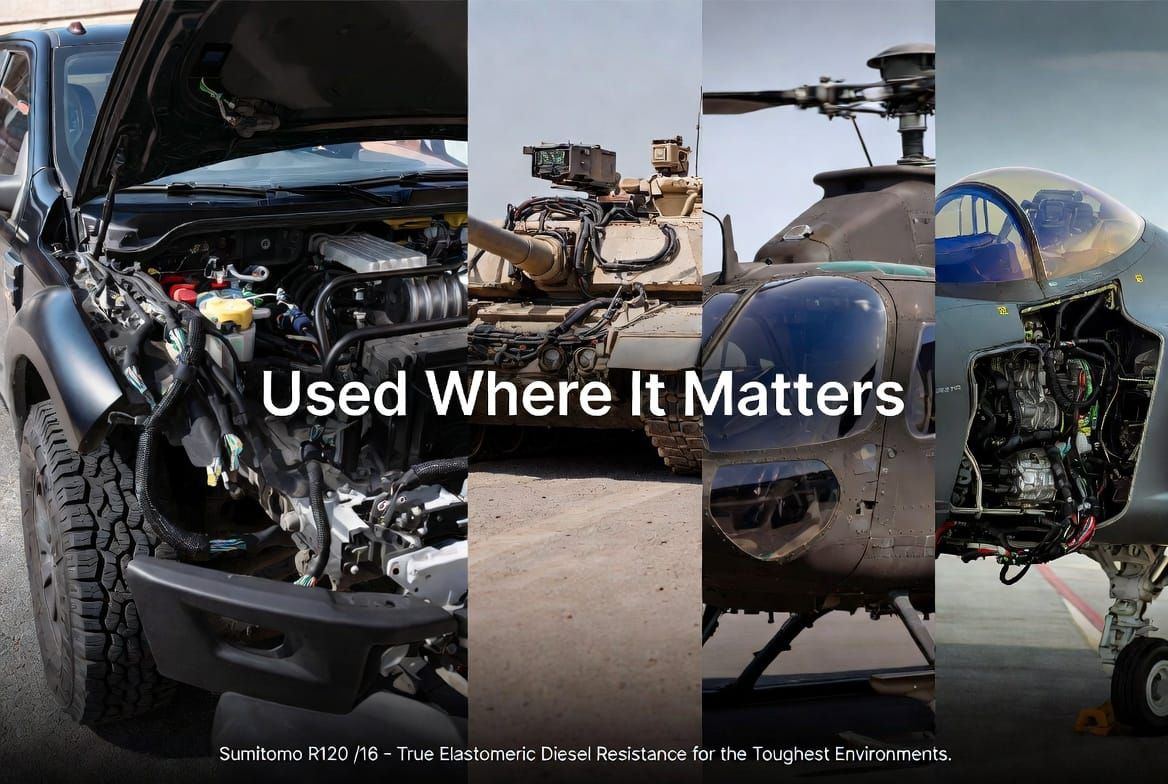
Specify Elastomeric Polyolefin whenever your wiring layout is exposed to engine compartments, heavy machinery chassis, or exterior aerospace wiring harnesses subject to continuous mechanical bending and persistent fluid contact. If your design demands minimum weight and bulk without compromising fluid immunity, utilize the R120(TW) profile. If you need a premium diesel resistant barrier or are cross referencing an existing DR-25 requirement, the best in class /16 specification is mandatory to guarantee long term fluid protection.
Choose /1 (Sumitomo R10) for "Inside the Box" Environments
Specify Chlorinated Polyolefin for internal enclosure routing, general purpose industrial control panels, or protected sub-assemblies. It provides excellent, rubber like abrasion defense where high end elastomeric snap back and continuous diesel saturation are not system bottlenecks, allowing you to capture that 10% to 15% budget savings.
5. Procurement and Technical Reference
For direct material cross referencing, sourcing data sheets, or to contact procurement support, visit the official manufacturer directories at Sumitomo Electric Interconnect Products:


SCM2 wasn’t designed for hobby projects. It was built for tough industrial environments, construction equipment, communications infrastructure, and heavy machinery. Sumitomo engineered this heavy wall, adhesive lined tubing to survive relentless vibration, abrasion, moisture, and harsh chemicals.
We’ve been testing it extensively in the field, and while it was made for industry, we’ve found it solves a surprising number of real world repair problems that normal heat shrink or two part epoxy simply can’t touch. Around here, we call it the "Liquid Weld."
Here is a look at what makes this material different, how it actually works, and the field discoveries that have made it a staple in our toolboxes.
What Makes SCM2 Different
This is not standard electrical tubing; it is true dual wall tubing. It features a thick, cross linked polyolefin outer jacket paired with a massive inner layer of hot melt adhesive.
When heated to its shrink temperature of around 115°C (239°F), the inner adhesive completely melts. As the robust outer wall shrinks down with serious mechanical force, it pushes that liquid adhesive into every crack, crevice, and thread underneath it.
The result is a thick, rigid encapsulation yielding up to a 2.5 mm wall thickness on the larger sizes that seals, bonds, and reinforces the joint. Because of its specific chemical formulation, the hot melt adhesive bonds exceptionally well to:
• Metal (Aluminum, Copper, Steel, Lead)
• Plastics (Polyethylene, PVC)
• Rubber
• Wood
A Warning to the User: Once SCM2 cools and that bond sets, it is extremely difficult to remove. Make absolutely sure you have the tubing positioned correctly before you apply heat, because you cannot simply slice it away with a razor blade later.
Proven Industrial Uses & Field Discoveries
Because SCM2 acts as a mechanical splint and an absolute moisture barrier, its use cases go far beyond standard wire insulation. This material was built for serious environments, and it shows.
Here are the proven industrial applications and field discoveries where SCM2 excels:
• Heavy Equipment and Off Road Vehicles: Provides brutal undercarriage protection for rugged utility trailers and heavy haulers exposed to road salts and magnesium chloride.
• Frame Reinforcement: Used to sleeve and reinforce cracked or rusted frame tubes on go karts, ATVs, and commercial mowers. The adhesive fills the pits while the jacket locks out future moisture.
• Wiring Harness Protection: The ultimate solution for sealing and protecting vulnerable wiring harnesses on trailers, trucks, and construction equipment against abrasion and water ingress.
• Tool Handle Rescue: Perfect for repairing damaged or splintered tool handles (shovels, axes, pry bars) and creating thick, durable grips on heavy impact tools.
• Outdoor Infrastructure: Protects joints on metal fencing, light poles, and outdoor infrastructure to halt rust and provide rigid mechanical support.
• Low Pressure Hoses and Plumbing Penetrations: Ideal for low pressure applications like fixing cracks in your everyday garden hose or sealing around plumbing penetrations where pipes go through walls. For actual pressurized plumbing or irrigation systems, traditional repair methods are still recommended.
• Telescoping Metal Connections: Ideal for reinforcing antenna masts, flagpoles, and any telescoping metal poles to prevent the sections from wearing against each other.
Important Notes & Application
While SCM2 is incredibly durable, it is important to understand its operating limits to ensure a safe and permanent repair:
• Temperature Limits: SCM2 has a maximum continuous operating temperature of 120°C (248°F).
• Where NOT to use it: It should not be used on hot exhaust components, engine blocks, or directly on high voltage battery cables where temperatures exceed its rating.
• Application Tooling: A standard bathroom hair dryer will not get hot enough to melt the adhesive. A dedicated industrial heat gun is the proper tool for the job. If you are in the field without power, a butane torch can be used carefully, just keep the flame moving so you don't scorch the outer polyolefin jacket.
Always verify the repair is appropriate for your specific application and operating conditions.
Where to Source SCM2
Whether you are a mechanic outfitting a shop or a procurement manager maintaining a fleet of commercial trailers, getting your hands on authentic Sumitomo SCM2 is straightforward.
• Where to Buy: Head over to Heatshrink.com to secure your supply. (Pro Tip: Mention you saw this article on Wire & Cable Insider, you might just receive a discount on bulk orders!)
• Official Manufacturer Data: To verify the exact engineering specifications, check out the official data straight from the source: Sumitomo IRRAX™ Sleeve SCM2 Official Specifications
Disclaimer & FTC Disclosure
Wire & Cable Insider is an independent, educational publication dedicated to analyzing hardware architecture and the physical layer of the tech industry. To provide the most accurate and raw insights, this site is operated by an active industry professional.
Transparency Statement: The author is currently employed within the Sumitomo Electric Group Companies (SEG). However, all views, technical analyses, and opinions expressed on this website are strictly those of the author. They are completely independent and do not represent the official policy, position, endorsements, or views of SEG, its subsidiaries, or any other manufacturer mentioned on this site.
Content is provided strictly for general informational and reference purposes. We claim no liability for any property damage, injury, or failed repairs that may result from the use or misuse of the information provided. Readers must independently verify all specifications, technical data, and safety standards with the respective manufacturers before use in live environments.