The Rugged Reality of Robotic Baristas: How Industrial Hardware is Feeding the Future
Will we have a robotic barista one day?
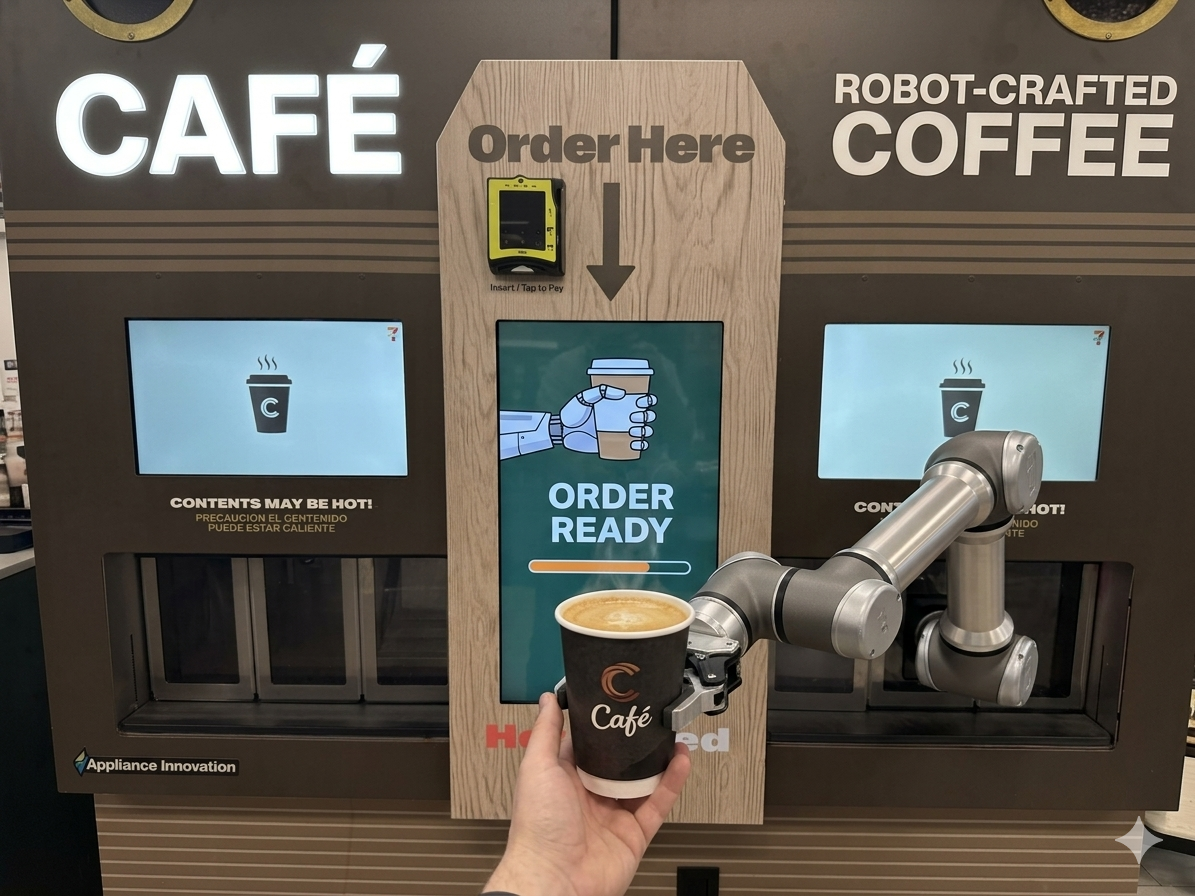
Look around the next time you walk through a major airport terminal. You will likely see a sleek, six-axis robotic arm perfectly pulling an espresso shot, steaming milk, and serving it to a weary traveler behind a pane of plexiglass. The autonomous food and beverage industry is no longer a concept for the distant future; it is operating right now.
But for interconnect and components engineers looking at these machines, the magic is not in the software or the code. It is in the sheer engineering time, massive upfront investment, and rugged hardware required to survive the absolute brutality of the general public.
The Physics of Human Brutality
Think about the massive engineering time and upfront investment required to put these automated systems into the wild. Designers cannot just optimize for the internal robotics; they have to ruggedize the exterior against human handling.
Watch for yourself the next time you step into an elevator. Nobody presses a button nicely. People jab them, punch them, and mash them as if the button personally insulted their family. We do not know what those elevator buttons ever did to anyone, but legacy companies like Otis had to spend decades mastering the physics of surviving human brutality.
Autonomous food kiosks face that exact same public wrath. When a machine is dispensing boiling liquids or flipping burgers without human supervision, a single broken interface shuts down the entire revenue stream. This is why the industry refuses to skimp on quality. They willingly pay fifty dollars for a single exterior switch because it has to be completely vandal-proof, impact-resistant, and sealed tight against moisture and environmental abuse.
Who Are They and What Are They Building?
While there is an undeniable and massive concentration of these robotics innovators in California, this technological revolution is rapidly spreading across the country. To help planners and supply chain managers map out this landscape, here is the scannable executive summary of the major players from the West Coast to Texas and the East Coast pushing the boundaries of automated food and beverage.
Cafe X Technologies
- Who They Are: An innovative robotics firm transforming premium beverage distribution.
- Where They Are: California.
- What They Are Building: Fully automated, self-managing robotic coffee bars. These kiosks utilize high-precision robotic arms to pour custom espresso, steam milk, and serve complex hot liquids safely behind protective enclosures.
- Who They Are Doing It For: High-traffic transit commuters and airport travelers.
- The Hot Points: Highly visible high-runner systems are already actively deployed at San Francisco International Airport and San Jose International Airport. Public estimates place their size around 50 employees with revenues estimated under $10 million.
Sweetgreen Infinite Kitchen (Formerly Spyce)
- Who They Are: East Coast pioneers in automated bowl and salad preparation.
- Where They Are: Boston, Massachusetts.
- What They Are Building: Fully automated robotic kitchens that dispense, toss, and serve complex meals with perfect portion control and zero cross-contamination.
- Who They Are Doing It For: High-volume fast-casual diners who demand healthy food at rapid speeds.
- The Hot Points: Originally founded by MIT engineers under the name Spyce, this robotic cooking technology was so incredibly disruptive and successful that the company was acquired by Sweetgreen to automate their national retail footprint.
Costa Coffee Smart Cafe (Formerly Briggo)
- Who They Are: The automated coffee powerhouse of the South.
- Where They Are: Austin, Texas.
- What They Are Building: Connected coffee kiosks utilizing sophisticated internal robotics to craft highly customized gourmet coffee without human intervention.
- Who They Are Doing It For: Airport travelers, hospital staff, and corporate campuses.
- The Hot Points: Born in the massive tech hub of Austin, Texas, this automated barista concept proved so reliable and scalable that it was acquired by The Coca-Cola Company to deploy globally.
Miso Robotics
- Who They Are: The premier automation house for high-volume commercial kitchen operations.
- Where They Are: California.
- What They Are Building: Flippy, the autonomous robotic fry cook. This system automates the frying station by identifying, lifting, dipping, and shaking fry baskets in boiling oil.
- Who They Are Doing It For: Major quick-service restaurant chains and commercial fast-food brands.
- The Hot Points: They have achieved serious commercial adoption with active deployments in national chains like White Castle and Jack in the Box. They employ roughly 100 to 200 people with estimated revenues between $10 million and $20 million.
Starship Technologies
- Who They Are: The global leader in autonomous sidewalk delivery logistics.
- Where They Are: California (United States Headquarters).
- What They Are Building: Six-wheeled autonomous delivery rovers equipped with weather-sealed cargo bays and rugged tracking systems.
- Who They Are Doing It For: University students, corporate campuses, and localized neighborhood delivery networks.
- The Hot Points: This is a high runner in the delivery space with massive public adoption, having completed millions of commercial deliveries. They employ over 500 people globally with estimated revenues between $20 million and $50 million.
The Regulatory Reality: What Guidelines Are They Following?
What rules govern a robotic fry cook or an autonomous barista? These machines are not just smart; they are highly regulated commercial appliances. When building equipment that handles consumable food and boiling liquids, engineers must comply with rigid safety frameworks.
First, there is Underwriters Laboratories. Commercial robotic kitchens must pass strict electrical safety standards like UL 197 for commercial cooking appliances. This ensures that when a high-voltage heating element operates next to a kinetic robotic arm, the risk of electrical fire is mitigated.
Second, they must meet National Sanitation Foundation standards. NSF guidelines dictate that any surface or component in the food splash zone must be easily cleanable, non-toxic, and resistant to extreme washdown chemicals.
Internally, these robotics companies draft their own brutal ingress protection specifications. Because the machines face daily high-pressure hot-water washdowns, internal wiring and sensor panels must often exceed IP68 ratings.
Sealing the Senses: Integrating Industrial Sensors
To meet these massive regulatory and internal specifications, designers rely on industrial-grade sensors. Whether an automated kiosk is monitoring the exact pressure of an espresso steam wand or the extreme temperature of a deep-frying vat, industrial sensors are the central nervous system of the operation.
When building machinery that handles boiling liquids and pressurized steam, engineers typically turn to these heavyweights:
- Amphenol Advanced Sensors (www.amphenol.com): They are an absolute powerhouse for NTC thermistors and RTD temperature probes. These sensors are essential for monitoring boiling water in coffee machines or hot oil in fryers. Because they are constantly exposed to extreme thermal cycling, the transition point where the sensor metal housing meets the exiting lead wires is highly vulnerable to moisture ingress.
- Sensata Technologies (www.sensata.com): Sensata provides a massive portfolio of harsh-environment pressure transducers and thermal switches built specifically to handle caustic fluids, refrigerants, and extreme heat. Their media-isolated pressure sensors are perfect for monitoring the fluid lines of a robotic smoothie maker or an espresso pump, ensuring the system never overpressurizes.
The Heat Shrink Waterproofing Strategy
Selecting the sensor is only half the battle. The other side of the switch panel is where the real war against steam, condensation, and grease is fought.
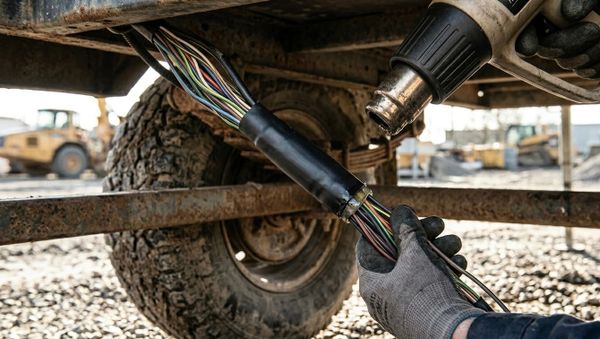
When you mount a fifty-dollar anti-vandal switch or a precision temperature sensor to a metal front panel, the front face might be perfectly IP68 waterproofed. However, the rear contacts and wire solder joints inside the machine are often completely exposed. In a robotic coffee kiosk, that internal cabinet is a literal jungle of ambient steam and humidity.
To absolutely waterproof these connections and pass strict UL and NSF washdown tests, engineers utilize dual-wall heat shrink from industry leaders like Sumitomo (www.seipusa.com). For organizations looking to implement this, their absolute beast of a material is the UL-recognized SCM2 product line, which is the go-to solution for extreme ruggedness and waterproofing.
Sourcing the Solution: The Heilind Advantage
You might engineer the greatest robotic arm in the world, but if you cannot reliably source the shielded cables, sensors, and dual-wall tubing that keep it running in a public airport, the product fails. Customers need options, secondary sources, and new solutions.
When it comes to sourcing these highly specialized sensors and components, supply chain managers turn to Heilind Electronics (www.heilind.com).
Heilind is an absolute giant in the interconnect and electromechanical industry, yet you would never know it by their customer support. They operate as a humble, privately owned business that treats every engineering team with massive respect. With extensive inventory and large branches spread across the United States, they are the go-to resource for ensuring that the innovators building the future of automation always have the exact parts they need.
The Multi-Billion Dollar Future: Shifting the Job Landscape
When we look at where this market will be one day, the revenue potential is staggering. Current market intelligence projects the food processing automation sector to reach $40 billion by 2030. Simultaneously, the pure food robotics segment is expanding at an explosive 20% annual growth rate, while autonomous delivery robots are surging at a massive 32% annual rate. Extrapolating this aggressive growth trajectory from 2030 to 2040 across the entire food and beverage automation ecosystem, an estimated valuation of $300 billion by 2040 is absolutely a fair and realistic target. It will undoubtedly become one of the largest and most critical industries in the world.
But this shift does not mean human labor disappears; it means the workforce evolves. The future of food and beverage will not be driven by minimum-wage, entry-level counter jobs. It is economically unsustainable to pay rising minimum wages for simple manual tasks if we want to keep everyday staples affordable. To deliver a clean, safe, and perfectly contained glass of orange juice at a price the average consumer can actually afford, automation is the only logical path forward.
Unlocking this value path ensures the jobs of the future will be far more technical, higher-paying, and highly rewarding. The workforce will shift to support industries built entirely around this infrastructure:
- Automated Supply Chain Managers: Specialists responsible for stocking, sanitizing, and replenishing the highly calibrated ingredients inside the machines.
- Field Service Technicians: Highly skilled electronics experts deployed to troubleshoot complex wiring harnesses, repair interconnects, and service kinetic robotic joints.
- Calibration and Maintenance Experts: Precision technicians ensuring that sensors, anti-vandal switches, and liquid routing valves remain safely within operational limits.
By replacing repetitive tasks with automated consistency, the industry is creating an entirely new ecosystem of technical careers that bridge the gap between engineering innovation and daily supply chain reality.