The Indestructible Nervous System: How Radiation Cross-Linked Fiber Optics Conquered Aerospace

In 1870, an Irish physicist named John Tyndall demonstrated that light could follow the curved path of a falling stream of water. He was witnessing Total Internal Reflection (TIR)—the physical phenomenon where light is completely trapped and guided within a medium.
A century and a half later, that exact physics principle is the central nervous system of every modern fighter jet, commercial airliner, and autonomous drone in the sky.
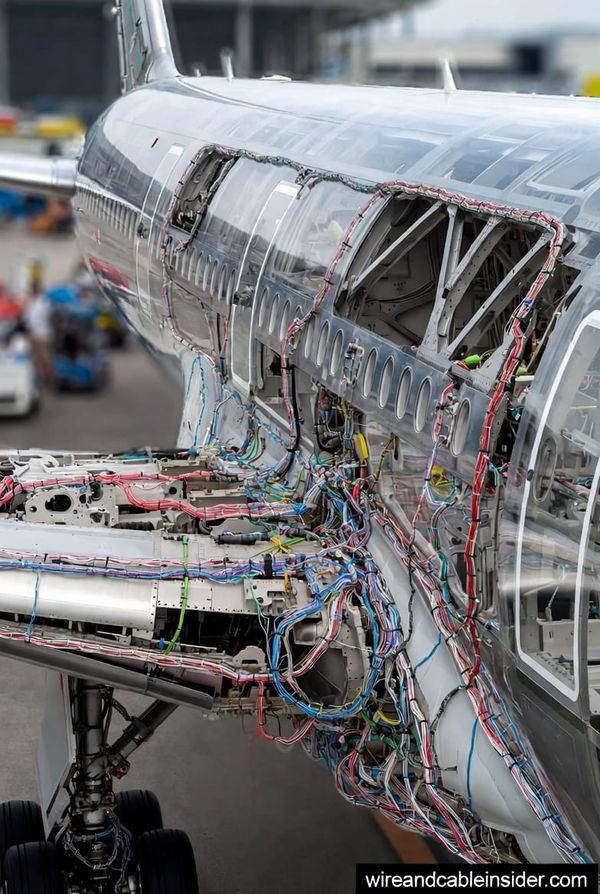
Today, airframes are drowning in data. Whether it is an electronic warfare platform transmitting uncompressed 4K radar images with zero latency, or a commercial airliner streaming high-definition video to 300 passengers simultaneously, traditional copper backbones have hit their physical ceiling.
To solve the modern SWaP (Size, Weight, and Power) crisis, aerospace engineers have adopted a hybrid architecture: utilizing fiber optics for the main fuselage backbone, and highly specialized, cross-linked Mil-Spec copper for the localized "final drop."
Here is the engineering reality of this hybrid network, the material science protecting it, and the definitive SAE-AS22759 decoding guide for procurement planners.
The Fiber Optic Backbone
When engineers replace main copper arteries with optical fiber, the weight and space savings are staggering:
- The 90% Weight Reduction: One meter of standard Quadrax copper cable weighs roughly 40 grams. One meter of aerospace-grade optical fiber weighs just 4 grams.
- The 77% Volume Reduction: Upgrading a bulky, single-channel electronic drop to a 4-channel optical solution reduces the physical routing footprint by over 75%, a critical victory for tight composite bulkheads.
- Zero-Spark Fuel Routing: Because optical fiber emits no electricity or heat, engineers can safely route data lines directly through jet fuel tanks to measure fluid levels without any risk of explosion.
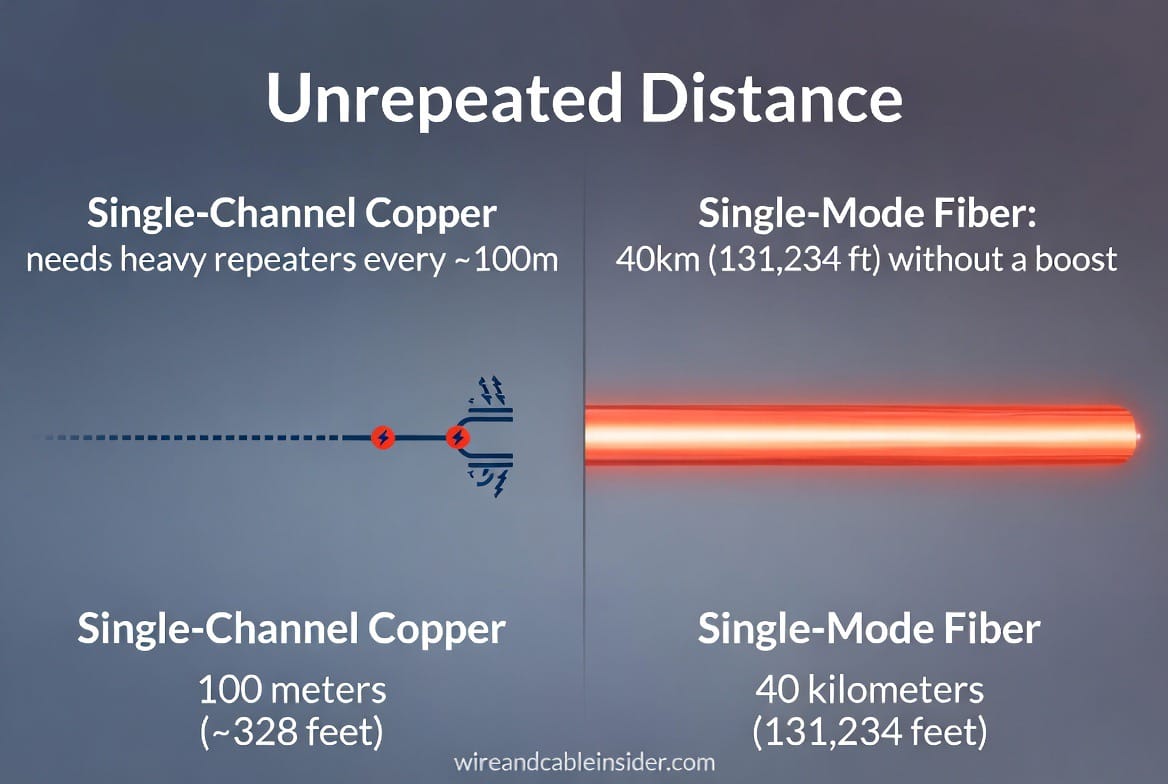
- The Unrepeated Distance: To push high-speed data over copper, you need heavy repeater amplifiers every 100 meters to boost the dying electrical signal. Single-mode fiber can push that same data for 40 kilometers before needing a boost.
Shattering the "Fragile Glass" Myth
There is a persistent myth that because fiber is made of glass, it is too fragile for the brutal mechanics of an airframe. The reality is that modern optical glass can be looped into a tight 7mm bend radius without snapping. It is then encased in a woven aramid yarn (Kevlar)—the exact same synthetic fiber used in body armor.
But Kevlar alone cannot protect the glass from the ultimate aerospace killer: Cold Flow. If a maintenance technician over-tightens a mounting clamp on a standard plastic wire jacket, the plastic slowly deforms under the pressure. Over time, this "cold flow" pinches the internal glass, distorting the optical signal and causing a catastrophic data failure.
The Material Armor: Radiation Cross-Linked ETFE
To prevent cold flow and extreme engine heat melting, the protective outer jacket cannot be made of standard commercial plastic. The industry gold standard for high-reliability fiber optic protection includes radiation cross-linked fluoropolymers such as ETFE, a core competency of Judd Wire.
When manufacturing their aerospace jackets, Judd runs the raw polymer through an intense electron beam accelerator. This massive dose of radiation fundamentally alters the chemistry of the plastic, forcing independent polymer chains to physically bond together into a permanent, 3D molecular grid.
This converts the material into a hardened thermoset that cannot melt and completely eliminates cold flow. It also creates extreme shock absorption: while the ARINC 802 specification for aerospace fiber requires a cable to survive 20 mechanical impact drops, Judd’s cross-linked jackets routinely survive 147 impact drops with zero fiber breakage. (Engineers can verify these metrics in Judd Wire’s Aerospace brochure here: -Judd Wire Aerospace Data - PDF
The Copper "Final Drop" (SAE-AS22759)
While fiber handles the massive data backbone, it cannot transmit the necessary electrical current to actually power the devices. Once the fiber reaches a localized transition box (such as a seat electronic box or a cockpit display unit), the architecture must switch back to copper.
This "last three feet" of localized power and data distribution requires extreme engineering. These copper wires must squeeze behind tight panels, survive continuous vibration, and withstand extreme temperature variations.
For design engineers and procurement planners, navigating the SAE-AS22759 (formerly MIL-W-22759) specification tree to find the right copper conductor and cross-linked insulation is critical.
The Aerospace Wire Decoder: Mil-Spec to Judd Equivalents
To streamline your Bill of Materials (BOM), we have translated the most common M22759 specifications directly into Judd Wire's radiation cross-linked ETFE (XLETFE) product families.
Thin-Wall Cross-Linked ETFE (Judd JWXLT Family)
Insulation layers that are 20% thinner than standard Mil-Spec XLETFE, offering massive weight savings for dense avionics bays while exceeding 60% contrast measurements for Excimer Laser marking.
| Mil-Spec Standard | Judd Wire Equivalent | Conductor Material | Insulation Wall | Max Temp |
|---|---|---|---|---|
| M22759/32 | JWXLT-32 | Tin-Plated Copper | Thin-Wall | 150°C |
| M22759/33 | JWXLT-33 | Silver-Plated High-Strength Copper Alloy | Thin-Wall | 200°C |
| M22759/34 | JWXLT-34 | Tin-Plated Copper | Thin-Wall | 150°C |
| M22759/35 | JWXLT-35 | Silver-Plated High-Strength Copper Alloy | Thin-Wall | 200°C |
Normal-Weight Cross-Linked ETFE (Dual-Layer)
Normal-weight variants offer brutal mechanical toughness and dual-layer cut-through resistance for exposed airframe routing and harsh under-engine environments.
| Mil-Spec Standard | Judd Wire Equivalent | Conductor Material | Insulation Wall | Max Temp |
|---|---|---|---|---|
| M22759/43 | M22759/43 | Silver-Plated Copper | Normal / Dual-Layer | 200°C |
| M22759/44 | M22759/44 | Silver-Plated Copper | Normal / Dual-Layer | 200°C |
| M22759/45 | M22759/45 | Nickel-Plated Copper | Normal / Dual-Layer | 200°C |
| M22759/46 | M22759/46 | Nickel-Plated High-Strength Copper Alloy | Normal / Dual-Layer | 260°C |
The Procurement Hack
Specifying cutting-edge fiber and M22759 Mil-Spec copper is only half the battle. Securing it without suffering 26-week manufacturer lead times or absurd Minimum Order Quantities (MOQs) is the true test of a procurement planner.
For high-demand airframe wire, the ultimate supply chain hack is WireMasters.
Smart procurement teams leverage WireMasters' massive, dedicated stocking strategy. They hold "boatloads" of highly specialized aerospace inventory, complete with all necessary QPL certifications, test reports, and lot traceability. When assembly lines are in danger of stalling, their technical team actively supplies in-stock equivalents—such as thousands of feet of WM22759/43 or WM22759/44 available by the foot—to keep production moving smoothly without waiting on the mill.
Conclusion
The future of aerospace infrastructure relies entirely on the successful marriage of optical light and electrical current. By understanding the material science protecting the fiber backbone, and accurately decoding the SAE-AS22759 standards for the final copper drop, engineers and buyers can confidently build the indestructible networks of tomorrow.
Disclaimer
Wire & Cable Insider is an independent, educational publication. Content is provided strictly for general informational and reference purposes. Because application environments vary wildly, readers must verify all specifications, technical data, and safety standards independently with manufacturers before using them in live environments. The views expressed here do not represent any specific manufacturer or employer.